
- Published on
Product Design Strategy
- Authors
- Name

Product Design and Process: A Case Study
My last two articles focused on execution and how leaders can concentrate on execution details to achieve product quality goals. However, this week, I am shifting my approach slightly, shifting my focus from execution. I am taking a step back to discuss strategy, specifically, how executive leaders should consider customer usage and perception to achieve the desired product quality.
Product quality, design, and the design process are influenced by how customers use and perceive a product or service. Introducing new products or modifying existing designs can affect various organizational functions, including marketing, operations, finance, and IT. Therefore, a systematic approach to design and the design process is essential for a product’s success. In this article, I examined the customer requirements for a multifunctional laser printer produced by Xerox and analyzed how these requirements and product usage impact the design process. Finally, I presented a brief marketing plan that incorporates these customer requirements.
About Xerox
Xerox is a global company that manufactures and markets printing and digital document products and services for home and business use. Its offerings include home office printers, office laser printers, multifunction printers, printing supplies, and solutions such as 3D printing and software applications. This report focuses on the AltaLink series printers designed for business users 1.
Variables for a High-Quality Product
According to 2, the eight elements of product quality are performance, features, reliability, conformance, durability, serviceability, aesthetics, and perceived quality. Customer requirements play a significant role in defining these elements. The customer requirements must be translated into technical requirements, which drive the manufacturing and design process. In addition to customer requirements, a few factors that enable measuring the product quality are human factors like ease of use, safety factors, and environmental factors, such as where this product is used. These factors include regular office spaces and places close to electrical equipment with high electrical interference.
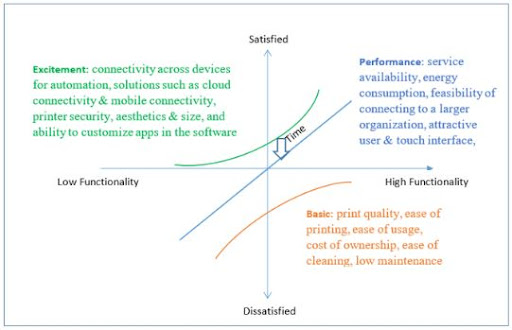
According to Kano’s model, there are three definitions of quality: basic, performance, and excitement. Basic features have a limited effect on customer satisfaction when they are present, but result in dissatisfaction if they are not present. Performance features represent a linear relationship between customer satisfaction or dissatisfaction with the level of functionality 3. By comparing the features available in business printers in the market, for a business printer, we can identify each of these requirements for business customers. The picture below depicts these features and how they change over time.
Product Usage
A typical business customer will buy these printers from a dealer or retailer who provides installation services and trains the customers on product usage and safety. These instructions should be simple and easy enough for different types of employees in the customer organization to follow. Since businesses employ people with varying skills, the product features should enable people with varying skill levels to connect to the device and print with minimal guidance. So, the IT and maintenance-related services must complement the product. Further, customers will be interested in functional values such as prints per minute, ink savings, paper usage, energy savings, device noise, and device life. Product usage and requirements vary based on the size and nature of the business. Large businesses may prioritize standard maintenance, internal collaboration, and automation, even with a higher cost. In contrast, small businesses generally prefer a cost-effective product with a longer lifespan, lower maintenance requirements, and greater energy efficiency. Impact of Customer Use on Design Since these printers offer multiple functions beyond printing, Xerox must consider these factors in the design process. Additionally, the company can standardize the manufacturing process to ensure consistent energy consumption and printing capacity across components. One approach to standardization should include measurement standards such as Energy Star energy consumption ratings 4. Since these products serve multiple purposes—such as printing, scanning, faxing, and emailing—the designers must consider modularity. Modular design involves breaking a product into relatively independent components that can be designed and manufactured separately 5. Xerox can apply this approach by developing the printer, scanner, and computing system modules separately while considering the interface complexity before integrating them. Since the product is designed for business use, factors such as ease of cleaning and consistent, reliable operation throughout its lifespan are crucial. Therefore, the design process should incorporate tools such as Failure Modes and Effects Analysis (FMEA), Six Sigma, and Design of Experiments (DOE) to assess and optimize product performance over time.
Additionally, each component can be designed to have improved reliability to increase product reliability. Xerox has been developing this product depending on the customer's demands and using modern technologies like laser technology. However, Xerox should continuously improve and introduce products with new features when new technologies are introduced. As the product degrades in performance, it reaches its end of life, and customers may want to replace, recycle, or repurpose the unit. Also, environmentally conscious customers like to recycle ink cartridges and other printing components and materials. Standardization and modularization in the design process will help repurpose some components. However, Xerox must adjust its supply chain and manufacturing process to introduce steps to recycle and reuse components.
Customer feedback. Xerox can conduct user research to observe customer behavior internally by setting up these products in its offices. The design team can use the captured user behavior and information from maintenance and service teams to understand system design and failures. It can further analyze the impact of sourced manufacturing material on product quality and life by setting up workshops with the suppliers 6. Finally, customer feedback can be captured through surveys and customer satisfaction scores to address design and service quality.
Marketing Overview
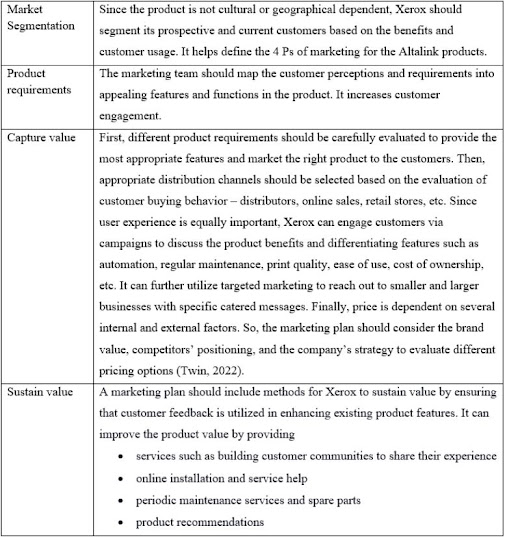
Altalink's marketing objective is to sell the product to every business customer worldwide. Considering this objective and customer needs, Xerox can consider the following five steps in the marketing plan.
- Segment the market into smaller segments based on business size & needs 7.
- Translate these needs into functional and technical requirements.
- Capture value by designing an integrated mix of product, price, place, and promotion. Sustain value by developing post-purchase services: It is much more expensive to attract new customers than to retain existing customers, and services provided after the product purchase play a critical role in establishing loyalty.
This article examined customer requirements for a relatively simple product and analyzed how these requirements and product usage influence quality, design, and the design process. While the case study focuses on a specific product, the concepts discussed apply to any product.
Footnotes
Xerox. (n.d.). AltaLink® C8100 Series Specifications. https://www.xerox.com/en-bm/office/multifunction-printers/altalink-c8100-series/specifications ↩
Garvin, D. (1984, October 15). What Does “Product Quality” Really Mean? MIT Sloan Management Review. https://sloanreview.mit.edu/article/what-does-product-quality-really-mean/ ↩
Stevenson, W. (2021). Operations management. (14th ed.). McGraw Hill. ↩
Bousquin, J., Esterman, M. & Rothenberg,S. (2011). Life cycle analysis in the printing industry: a review. RIT Scholar Works. http://scholarworks.rit.edu/books/93 ↩
Lu, Q., & Wood, L. (2006). The refinement of design for manufacture: Inclusion of process design. International Journal of Operations & Production Management, 26(10), 1123-1145. ↩
Design Council. (n.d.). A study of the design process. https://www.designcouncil.org.uk/sites/default/files/asset/document/ElevenLessons_Design_Council%20(2).pdf ↩
Tarver, E. (2022, May 28). Market Segmentation. https://www.investopedia.com/terms/m/marketsegmentation.asp ↩