
- Published on
Process vs Product
- Authors
- Name

Process vs. Product: When the Map Becomes More Important Than the Destination
In any successful business, the processes are the key. Otherwise, large businesses would quickly turn into chaos, because the processes provide consistency, minimize risks, ensure compliance, and allow scaling. But there is a trap that a lot of companies fall into - over time, the process begins to take precedence over the result it was originally created to achieve.
We've all seen projects that checked every box. The documentation was all done, every approval was obtained, and quality reviews were passed. Yet somehow the customer was still unhappy, release dates were slipped, and/or the final product had failed to deliver real value.
That triggers an uncomfortable question - Is the purpose of a process to ensure compliance or is it to help create a better product? Most people instinctively choose the later. Yet in practice, many organizations reward process adherence more than they reward the customer outcomes - that's where things start to go wrong.
The Paradox of Process
Processes exist for a reason - as organizations and their developed systems' complexity grows, coordination becomes crucial. Industries like aerospace, healthcare, automotive manufacturing, and finance simply couldn't operate safely and successfully without well-defined processes. So, the problem isn't process itself but the problem begins when a process becomes so rigid that one can no longer adapt it to changing reality.
The creators of the Agile Manifesto understood this well. Their message was never "ignore process." Instead, they emphasized that people, collaboration, and adaptability should take priority over following procedures and plans rigidly. That's an important distinction -Processes are a means to an end. Products, customers, and outcomes are the end. When we forget that, the map becomes more important than the destination.
When Process Turns Into Bureaucracy
Most organizations can recognize the symptoms when processes become the goal, even if they don't always acknowledge them.
- Three approvals for a low-risk decision.
- Status reports that nobody reads.
- Meetings held simply because the process says they must happen.
- Documentation created for compliance rather than understanding.
- Teams spending more time updating tools than improving products.
I've seen all of these firsthand - at first, they seem harmless but over time, they accumulate like debt, which slows down the progress, and subsequently impacting the product quality, and employee frustration. The irony is that the very processes created to improve efficiency end up creating friction.
Professional organizations and knowledge bodies like the Project Management Institute emphasize the importance of tailoring methodologies to the context of the work being performed. Yet, many organizations still follow and frameworks exactly as written, treating them as rulebooks rather than guides. When that happens, process stops removing obstacles and starts creating them.
The Hidden Cost of Rigid Processes
Slower Decision-Making
One dimension of change is market change i.e. markets move and customers' expectations change quickly. The other dimension is competitive advantage - as the competitors introduce new features, and new technologies evolve, companies lose competitive advantage if they don't act quickly. One dimension of change is market change i.e. markets move and customers' expectations change quickly. The other dimension is competitive advantage - as the competitors introduce new features, and new technologies evolve, companies lose competitive advantage if they don't act quickly. Unfortunately, governance structures tend to move much slower. So, when every decision needs to go through multiple reviews and approvals, organizations lose their ability to react quickly. So, the opportunities disappear while the teams are still waiting for all the approvals and decisions to be signed off. One of the original criticisms of traditional software development was the long lead time - i.e. the time it took from identifying a customer need to delivering a solution. The product eventually made it to market but the market had already moved on. Ironically, I've also seen organizations create elaborate processes around "being Agile." When you need a processes to enforce the Agile processes, then it's worth asking whether you're still agile at all.
Reduced Innovation
Innovators rarely develop breakthrough ideas by following a perfectly documented workflow because innovations often emerge from experimentation, feedback, learning, and occasional failure. That's inherently messy and it's all part of the nature of innovation. When organizations focus excessively on compliance, employees learn a subtle lesson - following the process is safer than challenging it i.e. you develop a "I'll do my job" attitude. As a result - your employees stop taking risks. Let me be clear—I am not advocating for chaos or cowboy engineering. Structure and Governance matter but innovation needs breathing room. So, the goal is a balance: enough discipline to manage risk, and enough flexibility to encourage discovery.
Lower Product Quality
This may sound counterintuitive but more process does not automatically result in better quality. In fact, beyond a breakeven point, the opposite can happen because teams put in too much effort on passing reviews instead of solving problems and creating value. Deliverables are created to just satisfy gates rather than to meet customer needs. Employees become experts at producing artifacts while slowly losing sight of the value those artifacts should create. True quality comes from balancing discipline and adaptability and that balance is usually more than simply adding another process step.
Product-Centric Thinking
The difference between process-centric and product-centric organizations comes from the questions we ask.
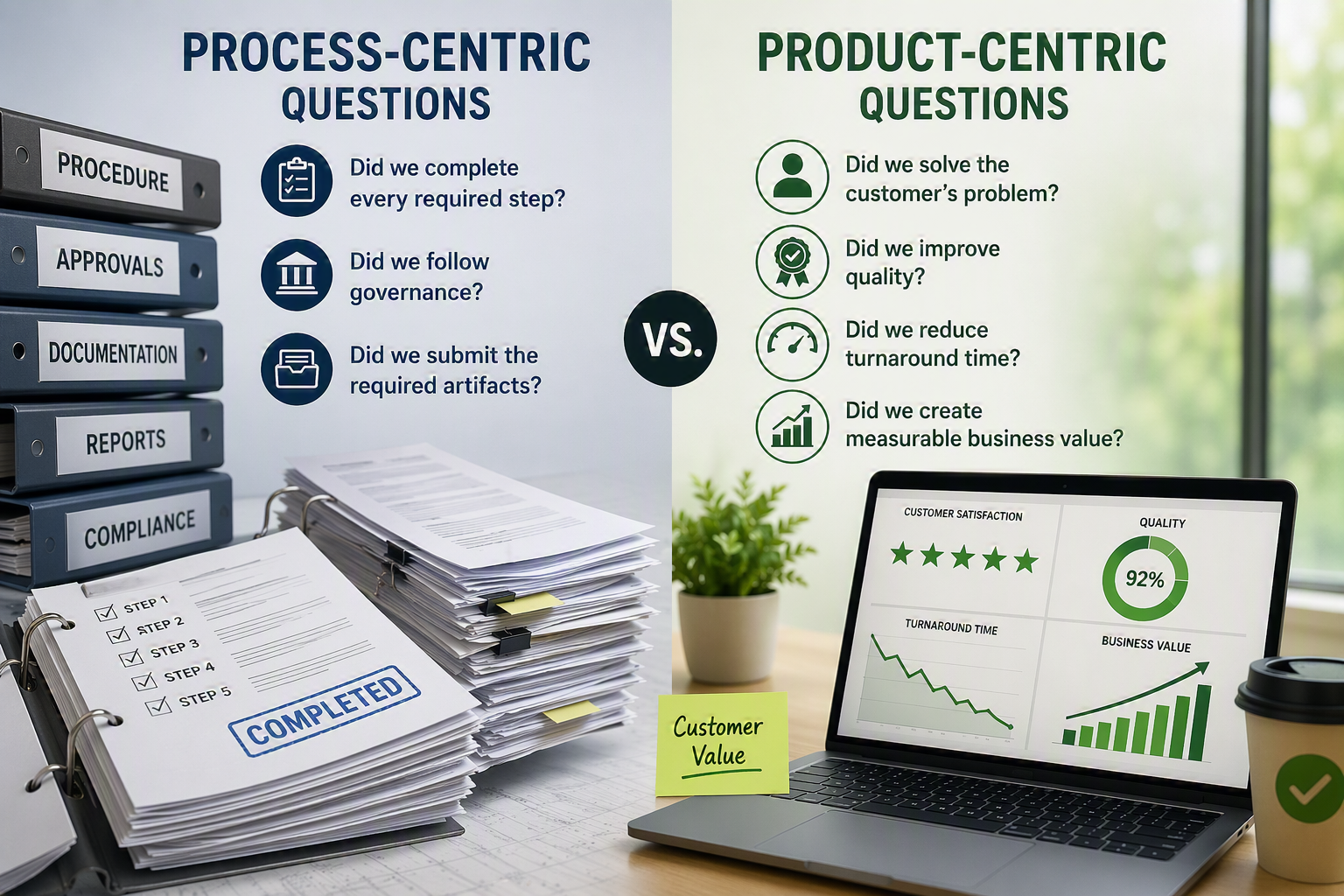
The difference seems subtle but when you dive deep, the driving philosophies are different i.e. one measures success through compliance and the other through outcomes.
A Practical Principle: The Minimum Effective Process One concept I find useful is what I call the Minimum Effective Process. The idea is simple - use only as much process as necessary to achieve quality, consistency, reduced risk, and transparency, but no more. A well-designed process should:
- Improve decision quality
- Reduce unnecessary risk
- Increase transparency
- Accelerate delivery
- Improve product quality
- Enable better collaboration If a process isn't helping in at least some of the above areas, it's worth asking why it exists in the first place because not every process adds value simply because it has existed for a long time.
Conclusion
The real debate is not process versus product - organizations need both. The challenge is to make sure that the process remains as a servant rather than becoming the master. The successful organizations understand that process is a tool and like any tool, its value comes from how it is used and what it helps create. They understand that too little process creates chaos and too much creates bureaucracy. So they find the balance and build enough structure to provide stability, enough flexibility to encourage innovation, and keep their focus where it belongs i.e. on the customer and the product. At the end of the day, customers rarely remember how well you followed your internal procedures but they will remember the product you delivered - that's exactly how it should be.